Affiliate disclosure: TinyCounter is reader-supported. If you buy through a link on this page, we may earn an Amazon commission at no extra cost to you. Read our Affiliate Disclosure and how we choose products.
The short answer
The best home coffee setup for small kitchens is three pieces, not ten: a Nespresso Essenza Mini for real espresso in a 4.3-inch-wide box, a Capresso Infinity Plus burr grinder for fresh beans without waking the household, and a COSORI CO108-NK gooseneck kettle for pour-over days. That trio covers espresso, drip, and pour-over on about 18 inches of counter. Add the Chemex 6-Cup when you want a slow weekend brew, and the Aeroccino bundle when milk drinks matter. Every pick below is an established Amazon listing rated 4.5 stars or higher — except one, the Chemex, whose US star rating Amazon hides from our checks, and we say so instead of guessing.
Quick picks: the best home coffee setup for small kitchens compared
| Piece | Model | Footprint (W × D) | Rating | Best for |
|---|---|---|---|---|
| Espresso machine | Nespresso Essenza Mini (Breville) | 4.3″ × 12.8″ | 4.5★ (thousands of ratings) | Best overall starter — real espresso, smallest box |
| Household brewer | Ninja Specialty CM401 | 8.75″ × 12″ | 4.6★ (19,660 ratings) | Best for households — one machine, six brew styles |
| Grinder | Capresso Infinity Plus | 5.4″ × 7.7″ | 4.5★ (~1,370 ratings) | Best overall grinder — quiet burr, fits anywhere |
| Grinder upgrade | Breville Smart Grinder Pro | 6.25″ × 8.5″ | 4.6★ (6,006 ratings) | Best for espresso + filter in one grinder |
| Pour-over brewer | Chemex Classic 6-Cup | ~5″ across, ~8.5″ tall | See note below | Best slow brew — brewer and carafe in one |
| Kettle | COSORI Gooseneck CO108-NK | 0.8 L | 4.6★ (~19,600 ratings) | Best pour-over kettle — 5 presets, 1-hour hold |
| Milk drinks | Essenza Mini + Aeroccino bundle | 4.3″ × 12.8″ + frother | 4.6★ (1,459 ratings) | Best for lattes & cappuccinos |
Ratings and specs below are manufacturer/Amazon listing data checked in November 2026. Prices change often on Amazon, so each pick links to its live listing instead of showing a price here. One honest exception: Amazon does not expose the Chemex 6-Cup’s US star rating to our checks, so we print no star figure for it — see its section for what we could verify.
How we chose these seven
We started with every well-reviewed piece of home coffee gear on Amazon, then applied the same filter we use across TinyCounter: established listings only (no new launches), 4.5 stars or higher, and high sales volume — thousands of ratings or a strong “bought in the past month” figure. Then the small-kitchen test, which is stricter than the rating test: a footprint that fits a short counter run, a height that clears standard upper cabinets, and a job the piece does every single day — not once a month. Gear that only does one thing had to earn its inches. The full process is on our Review Methodology page.
The three setups: buy in this order
A coffee setup is not a shopping list — it is a sequence. Buy in this order and you never own a piece you don’t use.
Setup 1 — The starter (one person, one cup). The Essenza Mini plus the Capresso grinder is overkill, so skip the grinder: the Mini uses capsules, not beans. Starter means the Mini alone, and a bag of capsules. Two pieces on the counter, one outlet, coffee in under a minute. If you drink milk drinks, buy the Mini with the Aeroccino bundle instead of the standalone machine — same footprint, lattes included.
Setup 2 — The everyday brewer (one or two people, every morning). Add the Capresso Infinity Plus grinder and the COSORI gooseneck kettle, and swap the Mini for the Ninja CM401 if the household wants a full pot as well as single cups. The grinder is the upgrade that changes the taste most: whole beans ground fresh beat any new brewer. The kettle is the upgrade that changes pour-over from guesswork to repeatable.
Setup 3 — The slow weekend (the ritual). Add the Chemex 6-Cup. It needs the grinder (medium-coarse, fresh) and the gooseneck kettle (slow, controlled pour) to work properly, which is why it comes last — on its own it is just a pretty glass carafe. With the other two pieces, it is the best cup of coffee in this guide.
1. Nespresso Essenza Mini by Breville — best overall starter
Key specs: 19-bar pump · 4.3″W × 12.8″D × 8.1″H · ~5 lb · 1260W · 0.6 L (20.3 oz) removable tank · heats in 25–30 seconds · 2 programmable cup sizes (Espresso 40 ml, Lungo 110 ml) · auto shut-off after 9 minutes · 4.5★ on Amazon with thousands of ratings
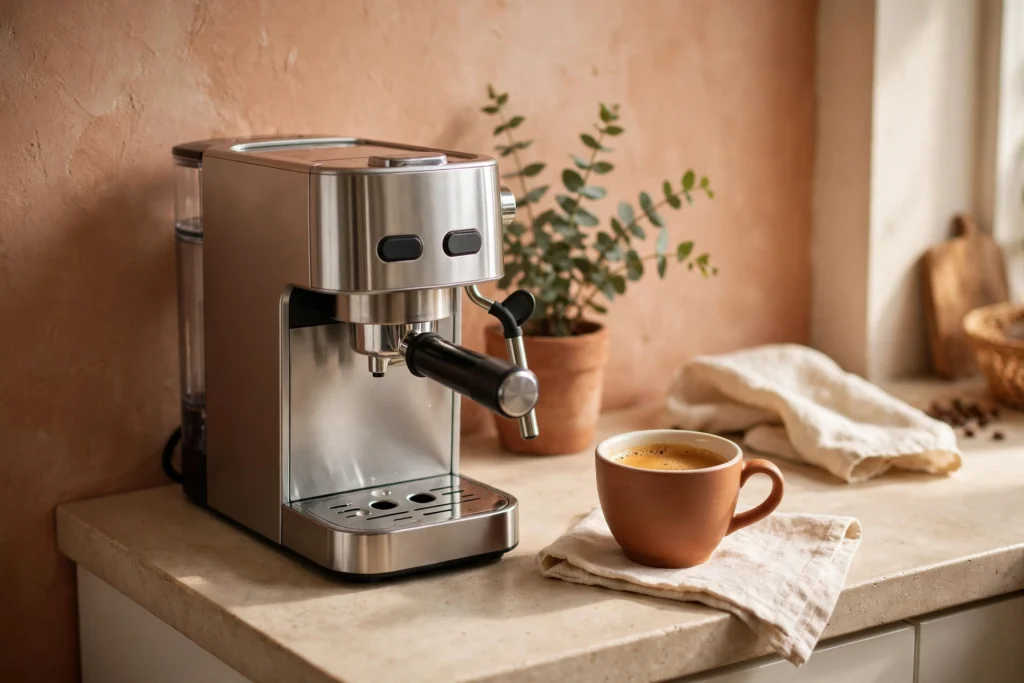
The Essenza Mini is the smallest real espresso machine Nespresso makes, and in a small kitchen that single fact decides almost everything. At 4.3 inches wide it takes up less counter than a toaster, and at about 5 pounds you can lift it into a cabinet with one hand. It is a genuine 19-bar pump machine — the same pressure class as machines three times its size — so the espresso it makes has real crema, not the thin brown water that cheap “espresso-style” brewers produce. One button, one capsule, one cup: it heats in under 30 seconds and shuts itself off after 9 minutes, which is exactly the morning routine a small apartment needs. And because it uses Nespresso Original capsules, you get the widest capsule choice in this guide — Nespresso’s own range plus dozens of third-party compatible pods.
Why it fits a small kitchen: the slimmest footprint of any real espresso machine here, light enough to store daily, and it disappears against the backsplash instead of claiming a corner of the counter.
Best for: anyone who wants real espresso in the smallest possible box, and who is happy with capsules instead of grinding beans.
Skip if: you drink milk drinks every day (buy the frother bundle below instead), or you refuse to pay per-capsule prices — ground coffee is cheaper per cup, and this machine locks you into pods.
Pros
- ✓ Slimmest footprint here — just 4.3 inches wide, lighter than a bag of flour
- ✓ Real 19-bar pump espresso with genuine crema, not “espresso-style” concentrate
- ✓ Heats in 25–30 seconds and shuts off automatically after 9 minutes
- ✓ Widest capsule choice — Nespresso Original plus third-party compatible pods
- ✓ 4.5★ on Amazon with thousands of ratings, and a listing live since 2017
Cons
- ✗ Capsules cost more per cup than ground coffee — the machine is cheap, the habit isn’t
- ✗ Small 0.6 L tank needs refilling often if two people drink from it
- ✗ No milk frother in the base model — lattes need the bundle below or a separate frother
- ✗ Only two cup sizes, and the light plastic body feels less premium than it looks
2. Ninja Specialty Coffee Maker CM401 — best for households
Key specs: 6 brew styles (Classic, Rich, Over Ice, Cold Brew, Specialty concentrate) · 8 sizes, single cup to 10-cup/50-oz glass carafe · 12″D × 8.75″W × 15.04″H · ~9.2 lb · fold-away frother · permanent filter · removable dishwasher-safe reservoir · SCA-certified · 4.6★ from 19,660 Amazon ratings
Let’s be plain about it first: the Ninja CM401 is not a pump espresso machine. It has no 15- or 19-bar pump, and the “Specialty” brew it makes is a concentrated coffee — strong, rich, and good over milk for a latte-style drink, but not true espresso. We include it because it is the best-rated machine in this price range by a wide margin (4.6 stars from nearly 20,000 ratings), it is SCA-certified, and it solves a problem the Essenza Mini cannot: one machine that brews a single cup for you and a full 10-cup pot for everyone else. Six brew styles cover classic drip, rich, over-ice, cold brew, and the specialty concentrate, the fold-away frother handles milk drinks, and the permanent filter means no paper filters to buy. It has been selling since 2019 — the most proven listing in this guide.
Why it fits a small kitchen: it replaces two machines — a drip coffee maker and a specialty brewer — in one box, and the frother folds away flat against the side when you’re not using it.
Best for: households where one person wants espresso-style drinks and everyone else wants a normal pot of coffee, and anyone who wants variety without a second appliance.
Skip if: you want true pump espresso with real crema — the Essenza Mini above is the pick for that — or if your upper cabinets are low: at 15 inches tall, measure before you buy.
Pros
- ✓ 4.6★ from 19,660 ratings — the largest and highest-rated owner base here
- ✓ Six brew styles in one machine, from a single cup to a 10-cup carafe
- ✓ Fold-away frother for lattes and cappuccinos without a second appliance
- ✓ SCA-certified and recommended by Consumer Reports for versatility
- ✓ Permanent filter and dishwasher-safe removable reservoir — cheap and easy to maintain
Cons
- ✗ Not a true espresso machine — the “Specialty” brew is concentrate, not pump-extracted espresso
- ✗ Tallest pick here (15.04″) — check your upper-cabinet clearance before ordering
- ✗ Biggest footprint of the three brewers, and ~9 lb — this one lives on the counter permanently
- ✗ Glass carafe breaks if dropped; the thermal-carafe twin costs more
3. Capresso Infinity Plus — best overall grinder
Key specs: 16 grind settings (extra fine to coarse: Turkish to French press and cold brew) · commercial-grade solid steel conical burrs · gear-reduction motor under 450 rpm (420 rpm) · 100W · 5.4″W × 7.7″D × 11.25″H · 4 lb · 11-oz bean hopper · 4-oz grounds container · 1–12 cup selector with timer and pulse grinding · 4.5★ from ~1,370 Amazon ratings, 300+ bought in past month
The Infinity Plus is the quiet grinder by design, not by marketing. Most burr grinders spin their burrs fast and loud; Capresso’s gear-reduction motor turns them at just 420 rpm, which keeps the noise down and — just as important for taste — keeps friction heat out of the beans. Whole Latte Love lists its sound level at 71 dB, and independent reviewers call it the quietest grinder in its price bracket. The 16 settings genuinely cover everything from extra-fine Turkish to coarse French press, and the timer dial lets you set a dose for 1 to 12 cups and walk away. On Amazon since January 2019, it is a known quantity, not a new launch riding a launch-week rating.
Why it fits a small kitchen: at 5.4 inches wide and 11.25 inches tall it takes up less counter than a kettle and fits under standard cabinets, and at 4 pounds it lifts into a cabinet between uses. The slow motor is the apartment-friendly part — grind at 6 a.m. without the whole flat hearing it.
Best for: apartment dwellers who brew drip, pour-over, or French press and want a real burr grinder that stays quiet and stays out of the way.
Skip if: you brew espresso on a non-pressurized basket daily — the Breville below dials in more precisely — or you grind a full pound at once (the 11-oz hopper suits a household, not a crowd).
Pros
- ✓ Genuinely quiet — gear-reduction motor under 450 rpm, listed at 71 dB
- ✓ 16 settings cover Turkish through French press and cold brew
- ✓ Smallest electric footprint here (5.4″ × 7.7″) and only 11.25″ tall
- ✓ Slow grinding preserves aroma — less heat and friction in the beans
- ✓ 4.5★ from ~1,370 Amazon ratings with 300+ bought in the past month
Cons
- ✗ Static can make grounds fly when you lift the grounds container — the recurring owner complaint
- ✗ Grounds can stick in the chute; some owners tap or bang the machine to clear it
- ✗ Light plastic housing feels less substantial than its steel burrs suggest
4. Breville Smart Grinder Pro — best grinder for espresso + filter
Key specs: 60 grind settings · Dosing IQ timer adjustable in 0.2-second steps · stainless steel conical burrs · 1-lb (450 g) bean hopper · 12-oz grounds container · grinds into a portafilter (50–54mm and 58mm cradles), grounds container, or filter basket · 6.25″W × 8.5″D × 15.25″H · 6.4 lb · LCD display · 4.6★ from 6,006 global Amazon ratings
The Smart Grinder Pro is the one-grinder answer for a household that brews more than one way. Sixty settings with a timer you set in 0.2-second steps means you can dial in an espresso dose on Monday and a French press dose on Tuesday and repeat both exactly — repeatability the Capresso’s cup selector can’t match. TechGearLab made it their top overall coffee grinder, scoring it best in class for grind consistency and ease of use, with a noise score of 8 out of 10 — one of the quieter electrics they tested. It grinds directly into your portafilter, so there is no container to spill and no extra step before brewing.
Why it fits a small kitchen: it takes no more counter than the Capresso — just 6.25 inches wide — but at 15.25 inches tall, measure your cabinet gap first (most kitchens have about 18 inches). In exchange, it is the only pick here that replaces both a filter grinder and an espresso grinder.
Best for: households that brew espresso and filter coffee from the same grinder, and anyone who wants timed, repeatable doses instead of guessing by eye.
Skip if: your cabinet gap is under 16 inches — the Capresso above will fit where this won’t — or you only brew drip and want the quietest, smallest option.
Pros
- ✓ 60 settings + Dosing IQ timer (0.2-second steps) for repeatable doses
- ✓ Grinds straight into a portafilter — no grounds container to spill
- ✓ TechGearLab’s top overall grinder, with the best consistency score in their test
- ✓ 4.6★ from 6,006 global Amazon ratings — the most-reviewed grinder here by far
- ✓ One grinder for espresso, drip, pour-over, and French press
Cons
- ✗ Tallest pick here (15.25″) — check your cabinet clearance first
- ✗ More fines at the coarse end, per lab testing — French press and cold brew are its weakest settings
- ✗ Some owners find it louder than expected, and the grounds-bin lid can spray a little coffee
- ✗ The premium pick of this roundup — more grinder than a drip-only household needs
5. Chemex Classic 6-Cup — best slow brew
Key specs: Borosilicate glass brewer + serving carafe in one · 30 oz capacity (6 cups at 5 oz each) · wood collar with leather tie · about 8.5″ tall, roughly 5″ across at its widest · 1.35 lb · dishwasher safe · uses CHEMEX Bonded Filters FP-1, FC-100, FS-100 or FSU-100 (filters not included) · listing live on Amazon since November 10, 2003 · 1K+ bought in the past month
The Chemex is the oldest piece of gear in this guide and the simplest: a glass hourglass, a thick bonded paper filter, hot water, patience. The thick filter is the whole trick — it strips out the oils and sediment that make French press coffee muddy, so the cup comes out clean and bright, with the bean’s lighter notes intact. It brews 30 ounces at once, which is two real mugs, and the glass carafe doubles as the serving vessel, so there is no second pot to wash. It has no plug, no buttons, and nothing to break, which is part of why a design from 1941 is still selling 1,000+ units a month.
A note on its rating, because honesty matters here: Amazon’s US listing for the Chemex 6-Cup does not expose its star rating to our checks — the rating block is hidden behind a cart wall in every crawl we ran — so we are not printing a star figure for it. What we can verify is the longevity (a listing live since 2003), the volume (1,000+ bought in the past month), and a cross-market signal: the same ASIN on Amazon Japan rates 4.8 stars from 6,574 ratings. We include it because the longevity and volume evidence is overwhelming, and we would rather tell you what we could not verify than invent a number.
Why it fits a small kitchen: it needs no outlet and no counter space of its own — it lives on a shelf or in a cabinet and comes out for the weekend brew. One vessel does the brewing and the serving.
Best for: slow weekend mornings, couples who brew two mugs at once, and anyone who wants the cleanest-tasting cup in this guide.
Skip if: you want coffee in under a minute on a weekday — the Essenza Mini is the weekday machine — or you don’t want to buy proprietary paper filters forever.
Pros
- ✓ Cleanest cup here — thick bonded filters remove oils, bitterness and sediment
- ✓ Brewer and carafe in one — nothing else to wash, no outlet needed
- ✓ A listing live since 2003 with 1,000+ bought in the past month — the most proven brewer here
- ✓ Non-porous borosilicate glass absorbs no odors or flavors
- ✓ The same ASIN rates 4.8★ from 6,574 ratings on Amazon Japan
Cons
- ✗ Needs CHEMEX Bonded filters — an ongoing cost, and no reusable filter option
- ✗ Slow by design — a pour-over takes minutes, not seconds
- ✗ Glass breaks if dropped, and the wood collar needs care around water
- ✗ We could not verify its Amazon US star rating — see the note above
6. COSORI Gooseneck Electric Kettle CO108-NK — best pour-over kettle
Key specs: 0.8 L capacity · 1200W quick heating · 5 one-touch temperature presets · 1-hour HOLD TEMP function · gooseneck spout for controlled pouring · 304 stainless steel interior, lid and spout · 4.6★ from ~19,600 Amazon ratings · 700+ bought in the past week · listing live since November 2019
Pour-over lives or dies on the pour, and the pour lives or dies on the kettle. A normal kettle dumps water; a gooseneck meters it in a slow, thin stream you can aim, which is what keeps the coffee bed evenly wet instead of channeling a hole through the grounds. The COSORI adds the part that matters second: temperature. Five presets put the water at the right heat for coffee or tea without a thermometer, and the one-hour hold keeps it there while you grind and set up. The 0.8-liter size is the small-kitchen point — it holds enough for two Chemex mugs and nothing more, so it never hogs the counter. At 4.6 stars from nearly 20,000 ratings, it is the best-reviewed kettle in this guide by a wide margin.
Why it fits a small kitchen: a 0.8 L body with a narrow base takes up less counter than a standard kettle, and it is the one piece here that serves coffee and tea equally — one kettle for both habits.
Best for: pour-over brewers, tea drinkers who want exact temperatures, and anyone whose current kettle pours like a waterfall.
Skip if: you only brew with a pod or drip machine and never pour by hand — the temperature control would go unused — or you regularly boil water for a crowd (0.8 L is two mugs, not a pot).
Pros
- ✓ 4.6★ from ~19,600 Amazon ratings — the best-reviewed kettle here by far
- ✓ Gooseneck spout gives a slow, aimable pour — the core of good pour-over
- ✓ 5 temperature presets plus a 1-hour hold — no thermometer needed
- ✓ 304 stainless steel interior, lid and spout — no plastic touching the water
- ✓ 0.8 L is exactly two mugs — small enough for any counter, 700+ bought in the past week
Cons
- ✗ 0.8 L is too small for boiling water for a crowd or a full pot of tea
- ✗ The presets are fixed — you can’t dial an exact degree between them
- ✗ Electric base means it needs an outlet spot, unlike a stovetop kettle
7. Nespresso Essenza Mini with Aeroccino Milk Frother — best for lattes and cappuccinos
Key specs: same Essenza Mini machine (19-bar pump, 4.3″W × 12.8″D, ~5 lb, 1260W, 0.6 L tank) + Aeroccino 3 milk frother · heats in 25–30 seconds · froths hot or cold milk at one touch · 4.6★ from 1,459 Amazon ratings
This is the same machine as pick #1, bundled with Nespresso’s Aeroccino frother — and it earns its own spot because it changes what the machine can do. The Aeroccino heats and froths milk at the push of a button, hot or cold, which turns a straight-espresso machine into a latte and cappuccino machine without adding a steam wand you have to learn. Owners rate the bundle slightly higher than the machine alone (4.6 stars), and the recurring praise in reviews is the same: it makes the best cup of coffee every time, with almost no learning curve. The frother is a separate small cylinder, so it lives next to the machine or in a cabinet — it doesn’t make the machine itself any bigger.
There is a reason the bundle is the frother pick and not a standalone frother: the standalone Aeroccino 3 rates 4.3 stars on Amazon, below our bar, and the Aeroccino 4 sits around 4.4. The bundle is how you get café milk drinks in a small kitchen without recommending a frother that doesn’t clear our rating bar.
Why it fits a small kitchen: you get milk drinks without a second appliance on the counter, and the frother is small enough to stash in a cabinet between uses.
Best for: latte and cappuccino drinkers who want café drinks at home without learning to steam milk.
Skip if: you drink your espresso black — the plain Mini above is the same machine for less, and the frother would sit unused.
Pros
- ✓ Same slim, proven machine as pick #1, plus real frothed milk at one touch
- ✓ Aeroccino froths hot or cold milk — lattes, cappuccinos, and iced lattes
- ✓ 4.6★ from 1,459 ratings — the highest-rated pick in this guide
- ✓ Frother is a separate piece, so the machine stays just as compact
- ✓ Still heats in under 30 seconds with the same one-button routine
Cons
- ✗ The frother adds a second item to store and clean
- ✗ Same small 0.6 L tank — two milk drinks in a row means a refill
- ✗ Capsule cost per cup is the same as pick #1 — pods are the ongoing expense
- ✗ Fewer ratings than the standalone machine, so the sample is smaller
Laying out a coffee corner in a small kitchen
The gear matters less than the layout. A coffee setup that works in a small kitchen obeys four rules.
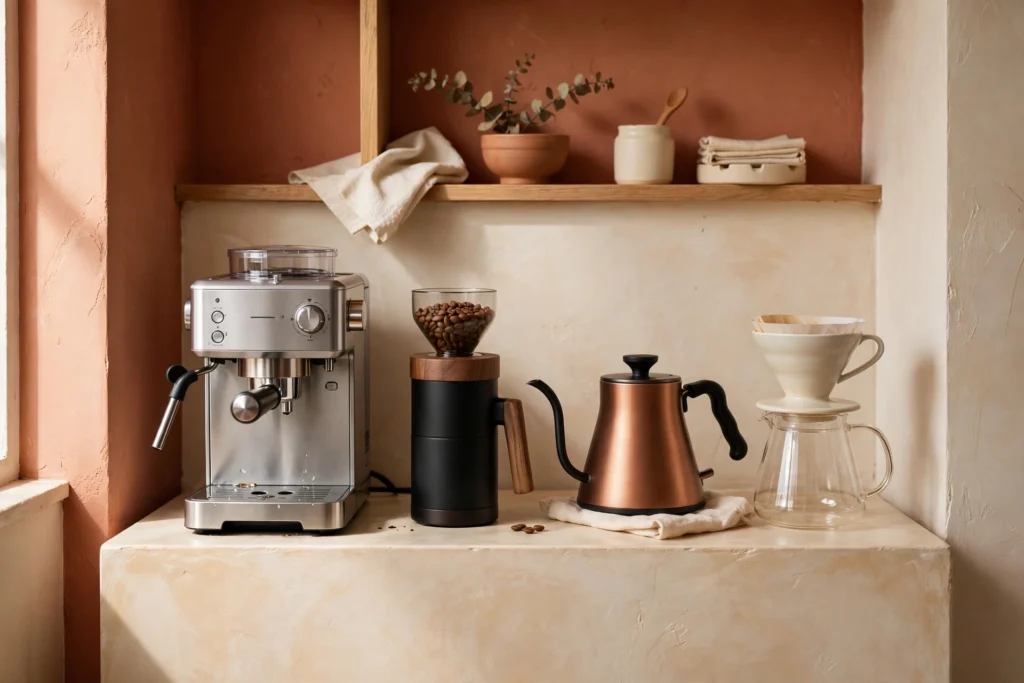
Rule 1: one zone, one outlet strip. Keep the brewer, grinder, and kettle within one arm’s reach of each other, on the same stretch of counter, sharing one outlet strip. Every step of the morning routine — grind, boil, brew — happens without walking. The pieces in this guide total about 18 inches of counter width if you park the grinder behind the brewer and the kettle beside it.
Rule 2: vertical storage for everything that isn’t electric. Capsules, filters, beans, and mugs go on a shelf or in a cabinet above the zone, not on the counter. The counter holds only the three electrics. A small tray under the brewer catches drips and defines the zone — and makes the whole setup look deliberate instead of cluttered.
Rule 3: measure height before you buy. Most kitchens have about 18 inches between counter and upper cabinets. The Essenza Mini (8.1″), the Capresso (11.25″), and the Chemex (~8.5″) fit anywhere. The Ninja CM401 (15.04″) and the Breville grinder (15.25″) fit too, but only just — and you need room above them to lift a water tank or hopper lid. Measure the gap, then measure the lid lift.
Rule 4: the grinder lives in a cabinet if you only brew once a day. The Capresso weighs 4 pounds and the 1Zpresso manual grinder from our grinder guide fits in a drawer. If the counter is truly tight, store the grinder and bring it out for the morning brew — thirty seconds of setup beats a permanently crowded counter.
Buying guide: five things to know before you build a home coffee setup
1. Pick your drink first, then your machine. Espresso drinkers need pressure (the Essenza Mini’s 19-bar pump). Drip and pour-over drinkers need a grinder and a kettle. Milk-drink lovers need a frother. Buying the machine before knowing the drink is how small kitchens end up with three appliances and one used.
2. The grinder is the upgrade that matters most. Pre-ground coffee goes stale within days of opening; whole beans ground fresh each morning taste noticeably better. A burr grinder like the Capresso changes the taste of every brew method you own. If your budget only stretches to one upgrade, buy the grinder.
3. Count the capsule cost, not just the machine cost. A pod machine is cheap to buy and expensive to run: capsules cost more per cup than ground coffee, every single day, for years. If you drink two cups a day, the pod habit costs far more than the machine within the first year. If that bothers you, the honest move is the Ninja CM401 with ground coffee — or accept the trade, as millions of Essenza Mini owners happily do, for the convenience.
4. Know which kind of “espresso” you’re buying. A pump machine (the Essenza Mini, 19 bar) forces hot water through coffee at high pressure and makes real espresso with crema. A pod machine is a pump machine with the grinding and dosing done for you. A specialty brewer (the Ninja CM401) makes a strong concentrate that tastes great over milk but is not espresso. All three are legitimate — but they are not the same drink, and the box won’t always tell you which one you’re getting.
5. Beware the famous-name trap. Several of the most-recommended machines in this category sit below 4.5 stars on Amazon — the De’Longhi Stilosa at 4.2, the ECP3420 around 4.1–4.4, the Baratza Encore at 4.1. Famous is not the same as well-rated. Every pick in this guide cleared our bar; the famous names that didn’t are listed below, with their ratings, so you can judge for yourself.
What we skipped, and why
Most coffee roundups list whatever is popular. We list what clears our bar — established listing, 4.5 stars or higher, high sales volume — and we name the rejections, because a guide that hides its rejections isn’t a guide.
- De’Longhi Stilosa (EC260BK) — the most recommended budget pump machine on the internet. It has 13,901 ratings, the longest owner record of any pump machine under $200 — but it sits at 4.2 stars, with failures and a plastic feel recurring in reviews. Below our bar, so it’s out.
- De’Longhi ECP3420 — Amazon’s best-selling budget pump machine. Its rating has drifted to roughly 4.1–4.4 stars depending on the listing, with leaking over time the most repeated complaint. Out.
- CASABREWS CM5418 and 3700 — popular 20-bar machines with strong marketing, but 4.3 and 4.2 stars respectively. Out.
- Gevi 20 Bar (GECME022-U) — the budget 20-bar pick in many roundups, but 4.3–4.4 stars, with durability complaints recurring in reviews. Out.
- Nespresso Aeroccino 3, standalone — the frother everyone buys on its own, at 4.3 stars from 9,400 ratings. Below the bar — which is why the frother pick in this guide is the Mini + Aeroccino bundle instead.
- Nespresso Aeroccino 4 — the newer frother, at roughly 4.4 stars. Still below the bar. Out.
- Fellow Stagg EKG Pro — the prettiest gooseneck kettle in coffee, and TechGearLab’s best pour-over pick — but its Amazon rating runs 4.1–4.4 stars depending on the color variant, below our bar. The COSORI above is the kettle that clears it.
- Baratza Encore — the most-recommended grinder in coffee forums, at 4.1 stars from ~16,700 ratings, with durability complaints a recurring theme. Out.
- OXO Brew Conical Burr Grinder — the best-selling burr grinder on Amazon by volume, but 4.3 stars from ~23,500 ratings. Out.
- Fellow Opus — beautiful design and a 2023 Red Dot award, but roughly 3.8 stars from ~1,800 ratings, the lowest of any grinder we checked. Out.
- Hamilton Beach Fresh Grind — hugely popular and cheap, but 4.3 stars from ~58,500 ratings — and loud, which defeats the point of a small-kitchen grinder. Out.
Frequently asked questions
What is the best home coffee setup for small kitchens?
Three pieces: the Nespresso Essenza Mini for espresso, the Capresso Infinity Plus burr grinder for fresh beans, and the COSORI CO108-NK gooseneck kettle for pour-over. Add the Chemex 6-Cup for slow weekend brews and the Aeroccino bundle for milk drinks.
Do I need a grinder if I only drink espresso from pods?
No. The Essenza Mini uses capsules, and the Ninja CM401 uses pre-ground coffee. You only need a grinder if you brew with whole beans — pour-over, drip, French press, or a pump machine that takes ground coffee. But the grinder is the single biggest taste upgrade in home coffee, so it is usually the first piece worth adding.
Is the Ninja CM401 a real espresso machine?
No — and we say so in the review. It has no pump, so its “Specialty” brew is a concentrated coffee, not pump-extracted espresso. It makes excellent latte-style drinks over milk, and it brews a full pot too, but if you want true espresso with crema, buy the Essenza Mini.
Why isn’t the De’Longhi Stilosa on this list?
Because it rates 4.2 stars on Amazon with 13,901 ratings, below our 4.5-star bar. It is the best of the sub-4.5 pump machines, and the most recommended budget espresso maker on the internet — but our bar is the bar, and we don’t lower it for famous names.
Will these pieces fit under my kitchen cabinets?
The Essenza Mini (8.1″), Capresso grinder (11.25″), Chemex (~8.5″) and COSORI kettle fit under standard 18-inch cabinet clearance with room to spare. The Ninja CM401 (15.04″) and Breville grinder (15.25″) fit most kitchens but need measuring — especially the space to lift a water reservoir or hopper lid. Measure before you buy, and check the layout section above.
Pod machine or ground-coffee machine — which is cheaper?
Ground coffee is cheaper per cup, by a lot. A pod machine costs less up front and more every day after. If you drink one cup a day, pods are a fair trade for the convenience. At two or more cups a day, a ground-coffee machine pays for itself — which is why the Ninja’s permanent filter keeps coming up in these conversations.
The verdict
A small kitchen doesn’t need a café — it needs three pieces that earn their inches. The Nespresso Essenza Mini by Breville is our default recommendation: the smallest real espresso machine you can buy, the fastest to heat, and the only pump machine under $200 that clears our rating bar. Add the Capresso Infinity Plus grinder when fresh beans matter, the COSORI Gooseneck Kettle when pour-over enters the routine, and the Aeroccino bundle when milk drinks do. Whichever setup you build, measure your counter first, count the capsule cost honestly — then buy once, and buy right.
Last updated: November 2026. Product specs, ratings and availability can change; the Amazon listing for each pick always shows the current details.